
About All Tours Sunrise ToursSunset ToursPrivate ToursBike ToursFrom Bangkok ToursFrom Siem Reap Tours Directions Hours & Fees
Find Tours 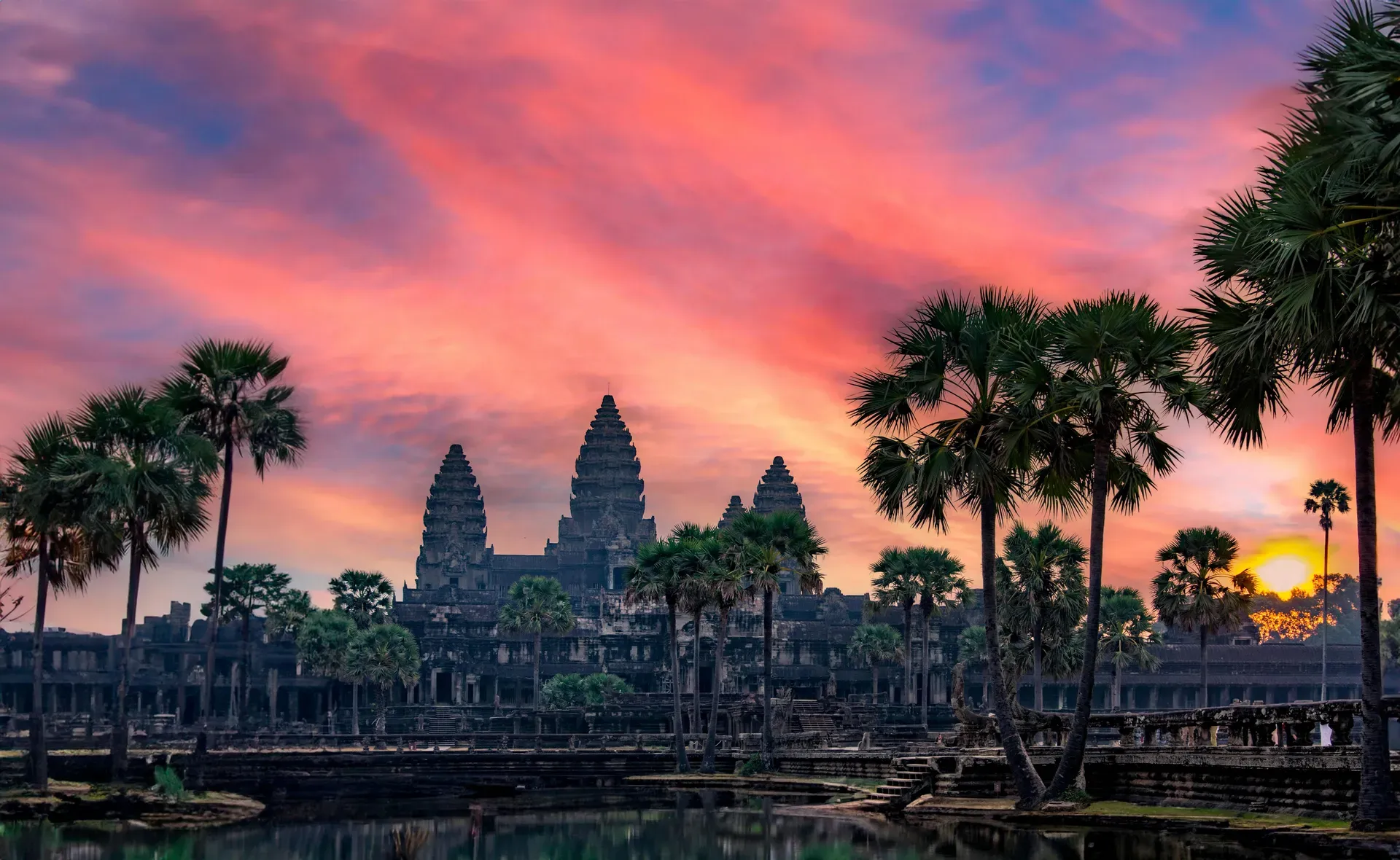
Angkor Wat is a 162.6-hectare Buddhist temple complex in northwestern Cambodia. Built in the 12th century, it holds the title of the world's largest religious monument.
Angkor Wat occupies 162.6 hectares of forest in northwestern Cambodia. King Suryavarman II ordered its construction in the early 12th century as a state temple and capital city. Today, it stands as the largest religious structure on Earth. Five sandstone towers rise 65 meters above the surrounding jungle, arranged in a quincunx to mimic the peaks of Mount Meru. A 200-meter-wide moat encloses the entire complex, creating a massive reflective boundary that spans 1.5 kilometers by 1.3 kilometers. Visitors cross a broad sandstone causeway on the western side to enter the grounds. The scale is difficult to process from the outer gate. You walk past 1,200 square meters of bas-relief carvings before reaching the central sanctuary. The sheer volume of stone rivals the Great Pyramid of Giza. Builders transported millions of sandstone blocks to construct the galleries, pavilions, and courtyards. The layout forces visitors to walk long distances between the outer gate and the inner sanctuaries. You will cover several kilometers on foot just exploring the primary structure.
The site transitioned from Hindu to Theravada Buddhist worship by the late 13th century. Monks in saffron robes still walk the stone corridors today. The environment dictates how you experience the ruins. Temperatures regularly hit 40°C in April, turning the stone courtyards into ovens. The monsoon season from September to October brings heavy rain that floods the outer pathways. Stones become slick with moss and water. You need sturdy, closed-toe shoes to navigate the steep, narrow stairs leading to the upper levels. Wheelchair access is limited to specific exterior routes and lower galleries due to the uneven terrain, sand paths, and lack of ramps.
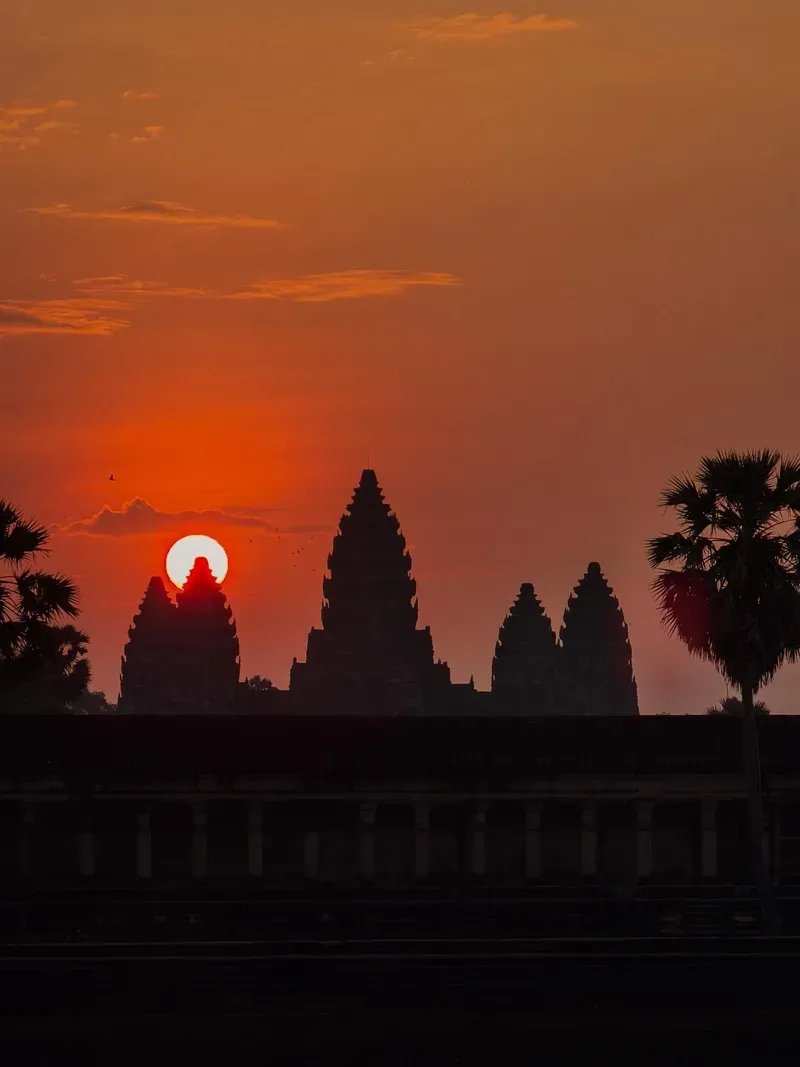
Crowds gather at the northern reflection pond by 5:15 AM daily. They wait in the dark for the sun to rise behind the five central towers. The resulting silhouette is the most photographed view in the country. Monkeys patrol the outer walls and frequently steal visible food or plastic bags from tourists. Tuk-tuk drivers wait near the exit, charging 15 to 20 USD for a full day of transport between the temples. Arriving 24 hours early to buy your official Angkor Pass online lets you bypass the morning ticket office queues on Road 60.
Construction on Angkor Wat began around 1113 AD under King Suryavarman II. The Khmer Empire required an estimated 300,000 laborers and 6,000 elephants to haul sandstone blocks from quarries at Mount Kulen, 50 kilometers away. The project took 30 years to finish. Suryavarman dedicated the complex to the Hindu god Vishnu, breaking from the Shaiva tradition of previous kings. The temple functioned as both the political center of the empire and the king's eventual mausoleum. Its western orientation aligns with Vishnu and the setting sun, a detail that sets it apart from other east-facing Khmer temples.
The Chams sacked the city in 1177. King Jayavarman VII responded by building a new capital, Angkor Thom, and a new state temple, the Bayon, just a few kilometers north. Angkor Wat lost its status as the political center but remained a vital religious site. By the late 13th century, the Khmer Empire adopted Theravada Buddhism. Workers modified the temple's iconography to reflect this shift. The Hall of a Thousand Buddhas once held hundreds of statues, though many were destroyed or stolen during subsequent centuries of conflict. The surrounding city was gradually abandoned, but the main temple never fell completely into ruin because the moat prevented the jungle from fully overtaking the stone structures.
The Japanese military occupied Cambodia during World War II, establishing a garrison near the temple grounds. Following the war, the region fell into decades of political instability. The Khmer Rouge took control of the country in 1975, executing millions of citizens and destroying countless cultural artifacts. Angkor Wat survived this period with minimal structural damage, though the surrounding forests became heavily mined. The Vietnamese army ousted the Khmer Rouge in 1979, but guerilla fighting continued in the jungles around Siem Reap throughout the 1980s.
French explorer Henri Mouhot published detailed accounts of the temple in the 1860s, drawing international attention to the site. The École française d'Extrême-Orient began formal conservation efforts in the early 20th century. Teams cleared vegetation and stabilized collapsing roofs. The site reopened to international teams in the 1990s. UNESCO designated the Angkor Archaeological Park a World Heritage Site in 1992. Today, conservationists battle water damage, bat guano, and the wear of 2.6 million annual visitors. International teams use laser scanning and ground-penetrating radar to map the buried infrastructure of the ancient city. Stay on the marked paths when exploring the outer park boundaries, as some remote areas still carry unexploded ordnance risks.
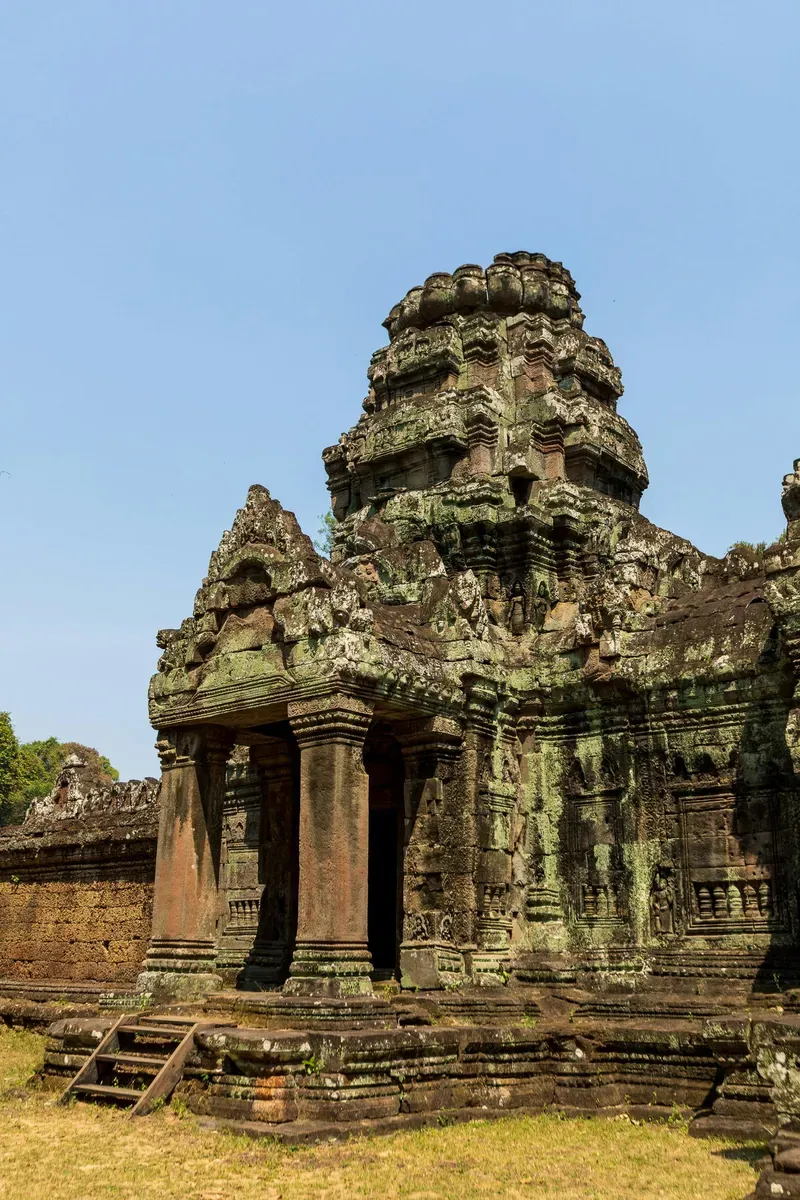
The surrounding moat does more than provide defense. The water prevents the sandy soil beneath the temple from expanding and contracting with the seasons, keeping the massive stone structures stable. Visitors cross a broad sandstone causeway on the western side to reach the outer wall. Inside, three rectangular galleries rise in concentric tiers toward the center. The galleries feature corbeled arches, a hallmark of classical Khmer construction where stones are stacked in progressively narrower layers until they meet at the top.
The East Gallery houses the Churning of the Ocean of Milk. This 49-meter-long bas-relief carving shows 88 asuras (demons) and 92 devas (gods) pulling on a giant serpent to extract the elixir of immortality. The sheer volume of stone carving is staggering. Across the complex, masons carved over 1,700 unique apsaras, or celestial nymphs, into the walls. Each figure displays distinct hairstyles, jewelry, and facial expressions. Flash photography is banned in these chambers to protect the ancient pigments still clinging to the stone.
The Bakan forms the third and highest level. Five towers sit in a quincunx pattern, with the central peak reaching 65 meters above the ground. The stairs leading to this tier incline at a 70-degree angle, forcing climbers to bow their heads in a posture of respect. Access is capped at 100 people at a time. Guards enforce a strict dress code here. You must cover your shoulders and knees with actual clothing; wrapping a scarf around a tank top will result in denied entry.
The builders used no mortar to bind the stones. The massive sandstone blocks fit together so tightly that the joints are nearly invisible. They rely on their own weight and mortise-and-tenon joints to stay upright. Iron clamps hold some of the larger blocks together internally. The laterite foundation provides a solid base, while the visible exterior consists entirely of fine-grained sandstone. The long, unlit corridors trap humidity, creating a heavy atmosphere during the wet season. Hire a licensed guide wearing a yellow or pink shirt to understand the complex mythology behind the specific carvings in each gallery.
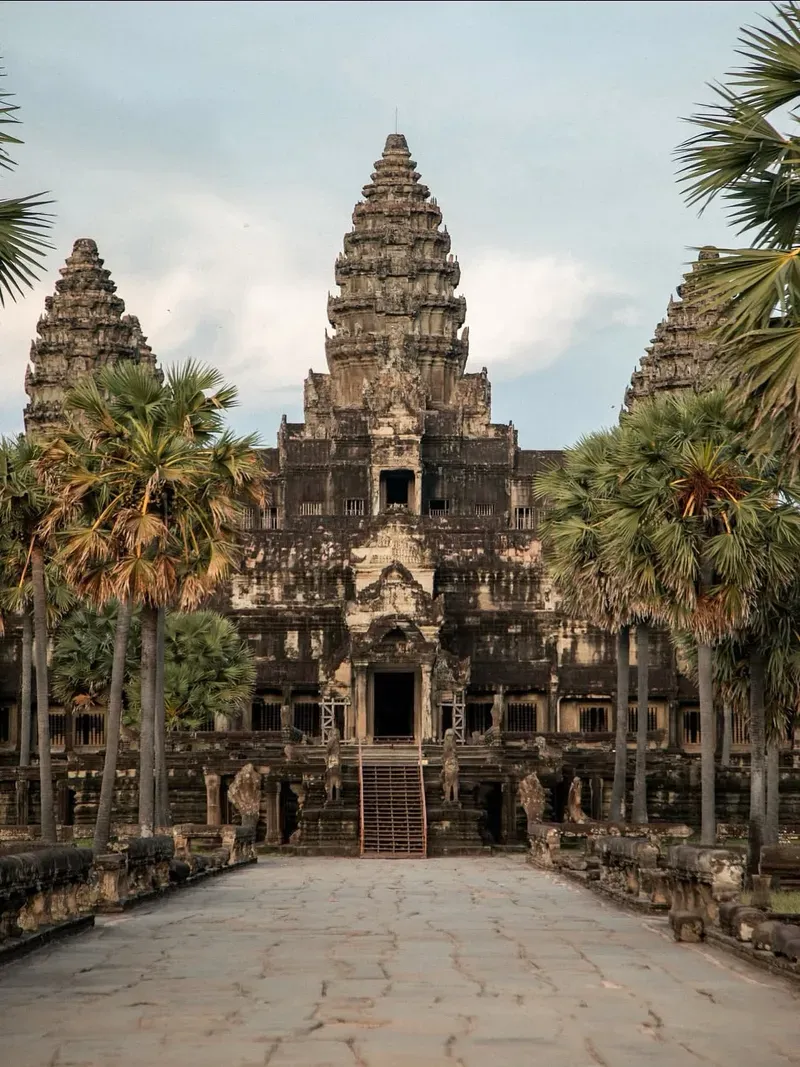
Angkor Wat anchors the Cambodian national identity. The temple's silhouette has appeared on every iteration of the country's flag since 1850. It represents the height of the Khmer Empire's engineering and artistic capabilities. The physical layout maps the Hindu cosmos. The central towers mirror Mount Meru, the home of the gods, while the outer walls represent the surrounding mountains and the moat symbolizes the cosmic ocean. This architectural translation of mythology provided divine legitimacy to the kings who ruled from its grounds.
The site operates as an active place of worship. Buddhist monks maintain shrines within the ancient galleries. Local residents visit during major religious festivals like Pchum Ben and Khmer New Year to offer prayers and light incense. The smell of burning sandalwood fills the central chambers during these holidays. The temple also dictates regional development. Siem Reap enforces a strict building code that prevents any new structure from rising higher than the 65-meter central tower of Angkor Wat. This law ensures the temple remains the dominant feature of the landscape.
The ruins heavily influence modern Cambodian art and classical dance. The intricate hand gestures of the Apsara dancers carved into the walls serve as a reference manual for contemporary performers. The Royal Ballet of Cambodia studies these 12th-century reliefs to reconstruct lost choreography. During the brutal years of the Khmer Rouge, the temple suffered minimal direct damage compared to other religious sites, though the surrounding forests were heavily mined. Its survival through centuries of war, regime changes, and natural decay makes it a powerful symbol of endurance for the Cambodian people. The annual Angkor Wat International Half Marathon draws thousands of runners who race through the archaeological park, raising funds for landmine victims and local hospitals. Visitors interacting with actual monks on the grounds must ask permission before taking photographs, and women are forbidden from touching them.
Unlike most Khmer temples that face east, Angkor Wat is oriented to the west, associating it with Vishnu and the setting sun.
The massive sandstone blocks fit together so tightly that the joints are nearly invisible, held in place by their own weight and mortise-and-tenon joints.
An estimated 6,000 elephants were used to transport sandstone blocks from Mount Kulen to the construction site.
Flying a drone anywhere in the archaeological park requires a specific government permit, and unauthorized equipment is routinely confiscated.
Macaques roam the temple grounds and frequently steal visible food or plastic bags from tourists.
The 200-meter-wide moat acts as a stabilizing mechanism, keeping the groundwater levels consistent so the sandy foundation doesn't collapse.
Kids under 12 do not need an Angkor Pass to enter, provided they have a valid passport to verify their age.
A 1-day pass costs 37 USD, a 3-day pass is 62 USD, and a 7-day pass is 72 USD. You must purchase these at the official Angkor Enterprise ticket center or online.
The main temple opens daily from 5:00 AM to 6:00 PM. The ticket office operates from 4:30 AM to 5:30 PM.
Yes. Visitors must cover their shoulders and knees. Sleeveless shirts, tank tops, and short skirts are strictly prohibited, and scarves used as makeshift wraps are often rejected at the upper levels.
November to February offers cool, dry weather suitable for long hours of walking. April brings extreme heat up to 40°C, while September and October see heavy monsoon rains.
Most visitors spend 3 to 5 hours walking through the main Angkor Wat complex. Exploring the wider archaeological park, including Bayon and Ta Prohm, takes 1 to 3 days.
The Siem Reap-Angkor International Airport (SAI) sits 51.4 kilometers away. An airport shuttle bus to the city takes about 60 minutes and costs 8 USD.
The site is not fully accessible due to uneven stones, sand paths, and steep stairs. Specialized tours can navigate specific ramps and exterior routes to view the lower levels.
No. Tickets are only sold at the Angkor Enterprise Ticket Center on Road 60 or through their official website. Gate staff only check passes.
King Suryavarman II originally constructed it as a Hindu temple dedicated to Vishnu in the 12th century. It transitioned into a Theravada Buddhist site by the late 13th century.
Hiring a tuk-tuk costs 15 to 20 USD for the day. The driver covers the 6-kilometer distance in 20 minutes and waits for you between different temple sites.
Browse verified tours with free cancellation and instant confirmation.
Find Tours